What you can do
Build trust on the shelf
Generate QR product labels that tell your story — ingredients, provenance, even cask history — straight from the data you already hold.
How it works
From batch data to a scannable story
Set a label template
Define what your label shows once, per product — with merge fields for batch details.
It fills itself in
Each batch resolves its own ingredients, dates and provenance into the label automatically.
Customers scan & trust
A QR code resolves to a clean public page — no app, no friction.
What powers it
Transparency that sells
Turn the provenance you already track into a reason to buy.
- QR-resolved public product labels
- Per-product templates with merge fields
- Cask & maturation provenance (for spirits)
- Allergens, ingredients & nutrition
A label that belongs to the batch
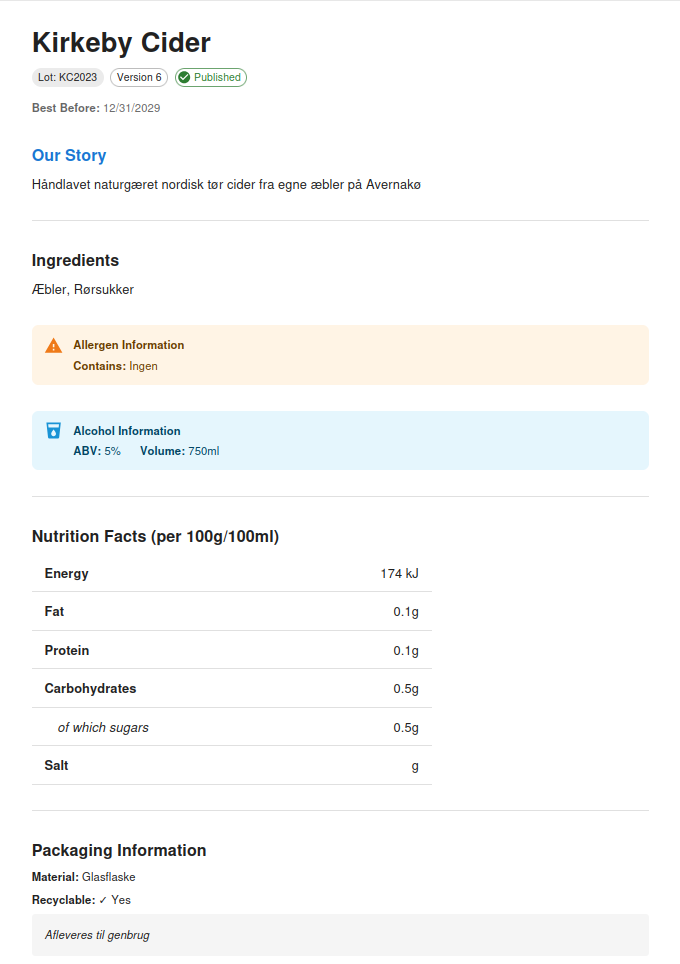
Digital labels in fermt are published per batch, not per product line. Each is versioned, deliberately published, and reachable by its own QR code generated as both PNG and SVG so it can be set at whatever size the physical label needs. The page carries the ingredient list, allergens and a nutrition declaration including energy in both kJ and kcal.
Publishing a corrected version does not invalidate what is already printed. The QR on the bottle keeps resolving and reaches the current published version, so a correction is a publish rather than a relabelling run — and because versions are retained, you can show what was published and when.
- Ingredients, allergens and nutrition per batch
- QR as PNG and SVG for any print size
- Versioned and published, with the history retained
- Bulk generation where a run needs many at once
EPR packaging reporting, from the same records
Extended producer responsibility asks a question most systems cannot answer: how much packaging material, by type, did you place on the market. fermt keeps packaging material types as real records — glass, cardboard, plastic and whatever else you use — each with a weight per unit, and the packaging report totals material weight by type across sales.
That means the EPR figure is a consequence of having sold things, rather than a spreadsheet someone assembles from product specifications at the end of the year. The same records feed the sustainability reporting, so packaging appears in your environmental footprint without being counted twice.
Questions we get
Labelling questions we get asked
Does this satisfy the EU wine e-label requirement?
It provides the per-batch page and the QR that reaches it, carrying ingredients, allergens and nutrition in kJ and kcal, which is what regulation 2021/2117 expects to be reachable from the bottle. You remain responsible for the accuracy of the content, as with any label.
What happens to printed QR codes if the label changes?
They keep working. The code resolves to the label's current published version, so correcting an error is a publish rather than a reprint.
Can we generate labels in bulk?
Yes, there is a bulk path for runs where many batches need labels at once, rather than publishing them one at a time.
How does EPR packaging reporting work?
You define packaging material types with a weight per unit, and the packaging report totals material weight by type across sales. The figure comes from what you actually sold rather than from a separate calculation.
Can the label carry marketing content?
Keep it to the mandatory particulars. For wine in particular the e-label is required to stay free of sales and tracking content, so fermt's label page is the regulated information rather than a landing page.
Who relies on this
Crafts that lean on this most
Ready to get out of spreadsheets?
Start your free trial today, or talk to us about your setup.