
What you can do
From order to paid
Take customer orders, ship with delivery notes, invoice as PDF — and sync it all to Dinero or e-conomic without re-typing.
How it works
Sell it, ship it, get paid
Take the order
Create sales orders against live stock, with the right price and currency.
Ship with papers
Generate delivery notes (følgesedler) so goods leave with full documentation.
Invoice & sync
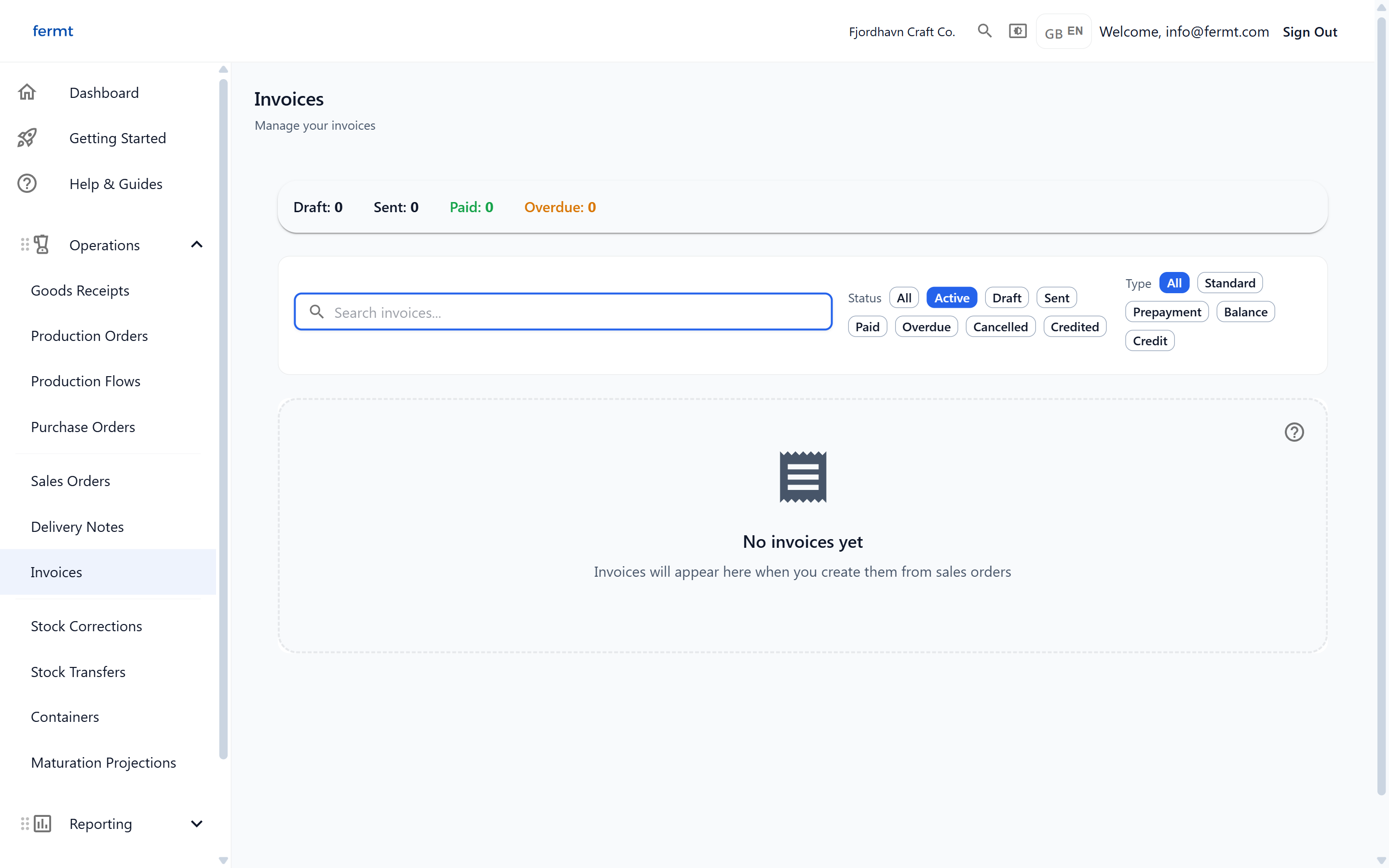
Produce PDF invoices and push them to Dinero or e-conomic automatically.
What powers it
Commercial, connected to production
No re-keying between making, selling and accounting.
- Sales orders against live stock
- Delivery notes with PDF
- Invoices with PDF generation
- Two-way Dinero & e-conomic sync
- Multi-currency pricing
The order is the document everything else comes from
A sales order in fermt allocates specific batches rather than an anonymous quantity, and both the delivery note and the invoice are raised from it. That ordering matters: it keeps the traceability chain intact all the way to the customer, so a question in March about a delivery made in November has an answer, and the stock that left is the stock the trace says left.
Delivery notes handle partial shipments, generate multilingual PDFs and record confirmation of receipt — useful when the customer is in another country and the paperwork has to be readable at both ends. Invoices follow from the same order, with credit notes, PDF generation and payment tracking.
- Delivery notes and invoices raised from the sales order
- Partial shipments, with multilingual delivery note PDFs
- Credit notes and payment tracking
- Batch allocation, so the trace runs through to the customer
It feeds your accounting rather than replacing it
fermt is not a ledger and does not try to be. It connects to the accounting system you already use — there are integrations for e-conomic and Dinero — so an invoice raised against a sales order reaches the books without being retyped, and inventory valued at actual batch cost goes across as a figure your accountant can use rather than one they have to rebuild.
Customer records hold the details that invoicing in practice depends on: payment terms, contacts, and the GLN/EAN number Danish municipalities and other public-sector buyers require before they will accept an invoice at all.
Accounting is where fermt connects today, and the list is growing. Sales-channel integrations — Shopify, Etsy, WooCommerce and similar — are in development, so stock sold online reconciles against the batches it actually came from. If a channel you depend on is not on the list yet, tell us: what customers ask for is what gets built next.
- e-conomic and Dinero accounting integrations
- Shopify, Etsy and other sales-channel integrations in development
- GLN/EAN numbers held against customers for public-sector invoicing
- Multi-currency procurement and invoicing with exchange rates
- Inventory valuation at actual batch cost, including work in progress
Questions we get
Sales and invoicing questions we get asked
Does fermt send electronic invoices?
It generates the invoice from the sales order, as a PDF, and holds the GLN/EAN number a public-sector customer needs. Sending it over a network such as Peppol is done by your accounting or e-invoicing provider — fermt integrates with e-conomic and Dinero rather than transmitting invoices itself.
Does this replace our accounting system?
No, it feeds it. Integrations for e-conomic and Dinero carry invoices across, and inventory valuation is produced from actual batch costs, including work in progress, so it can go into the accounts without being reworked.
Does fermt connect to our webshop — Shopify, Etsy, WooCommerce?
Not yet, and we would rather say so than leave you to find out. Sales-channel integrations are in development. Today, online orders are brought in as sales orders — by bulk Excel import, or through the API — which keeps the batch allocation and the traceability chain intact. Tell us which channel you sell through; the order we build them in follows what customers actually ask for.
Can we sell in other currencies?
Yes. Currencies and exchange rates are set up once and apply to both procurement and invoicing.
How are partial shipments handled?
Delivery notes are created from the sales order and can cover part of it, with multilingual PDFs and receipt confirmation. The order tracks what has shipped and what has not.
Do sales keep the batch trail?
Yes, because sales orders allocate specific batches rather than a bare quantity. That is what lets a trace run forward from a raw lot all the way to the customer who received it.
Who relies on this
Crafts that lean on this most
Ready to get out of spreadsheets?
Start your free trial today, or talk to us about your setup.