
What you can do
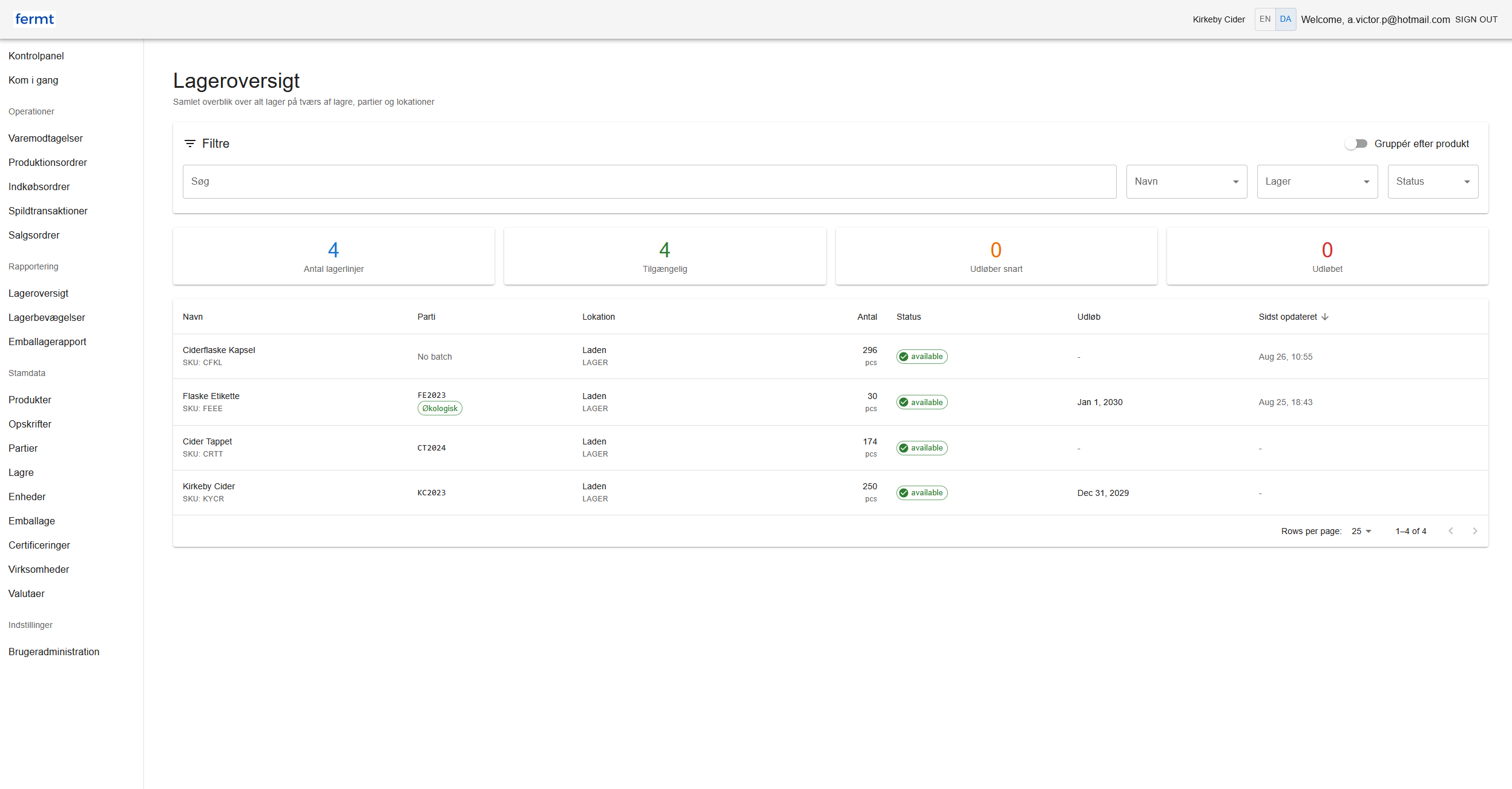
Always know what you have
Track ingredients and finished goods across locations in real time — and see what to reorder before you run out.
How it works
From purchase to shelf
Receive what you buy
Raise purchase orders, receive deliveries and book stock in — with batch numbers from day one.
Track it in real time
Every production run, sale and adjustment updates stock automatically across your locations.
Never run dry
See live levels and movements so you reorder in time and waste less.
What powers it
Inventory without the counting
Stock that keeps itself current as you work.
- Purchase orders & goods receipt
- Real-time stock across locations & warehouses
- Stock movements, adjustments & transfers
- Waste and spillage tracking
- Batch / lot numbers throughout
What it is worth, not just how much there is
A quantity is half an answer. fermt values stock at the actual cost of the batches on hand, so the figure you hand to your accountant comes from the receipts and productions that genuinely built it rather than from a price list someone updated last year. Costs are captured at goods receipt, carried through production, and reported as a valuation you can run for any point you need.
Because the valuation and the quantity come from the same movements, they cannot drift apart. There is no month-end exercise where the stock report and the ledger have to be argued into agreement.
The report separates raw materials, finished goods and work in progress, the last taken from production orders whose inputs have been consumed but whose outputs are not yet finished — the value genuinely sitting in the tanks rather than on a shelf. It runs for a past date as well as today, which is what primo and ultimo figures need, and exports to Excel for whoever does your accounts.
- Actual batch cost, traced back to the goods receipt and purchase price
- Batches produced in-house costed from the sum of their inputs, recursively
- Raw materials, finished goods and work in progress reported separately
- Any date, not only today, and exported to Excel
Every movement, and why it happened
Stock movements are an audit log rather than a running total: every stock-in and stock-out event is recorded with its date, product, warehouse and transaction type, and can be filtered on any of them. When a figure looks wrong, the question is not what the balance is but what happened to it, and that is what the log answers.
Corrections are treated as events too. After a stock count, an adjustment records the increase or decrease with an audit trail, and a guided correction path helps you choose between a reversal, an adjustment and a waste record according to what actually went wrong. Waste, spoilage and destruction are recorded as their own transactions, adjust inventory automatically, and feed the compliance reports rather than disappearing into a generic write-off.
Which batch gets used stays your decision. Adding a production or sales line pre-fills the oldest batch that has stock available, and the picker lists every batch for the product ordered by manufacturing date with the ones holding stock first. So oldest-first is a starting point and an ordering, never a constraint: allocating by expiry, or reserving a specific lot for a customer who asked for it, are ordinary requests rather than fights with the system.
Several locations, several units, one picture
Warehouses have addresses, capacities and purposes, and every transaction is associated with one, so stock is answerable by location rather than as a single company-wide number. Transfers move material between them as recorded movements.
Units of measure carry conversion factors, which matters more than it sounds: buying in kilos, producing in litres and selling in bottles is the normal case, and a system that cannot convert consistently produces exactly the sort of unit mismatch that turns into a reporting error later.
Questions we get
Inventory questions we get asked
How does fermt cost our stock?
At the actual cost of the batches on hand. fermt follows the batch back to the goods receipt line and the purchase price behind it, and where a batch was produced in-house it sums the costs of the inputs that made it, recursively down the chain. There is no weighted-average option: the cost is the batch you actually hold.
Can we see stock as it was at a past date?
Yes. Because the movement log is the source of truth rather than a running total, a valuation or balance can be produced for the period you ask for.
How do we correct stock after a count?
With a stock adjustment, which records the increase or decrease with an audit trail and a reason. If you are not sure whether the right answer is an adjustment, a reversal or a waste record, the guided correction path walks through it.
Do you handle several warehouses?
Yes, with transfers between them recorded as movements. Every transaction is associated with a warehouse, so stock is answerable by location and not only in total.
We buy in kg and sell in bottles. Is that a problem?
No. Units of measure carry conversion factors and are applied consistently across transactions, which is what keeps a purchase in kilos, a production in litres and a sale in bottles reconciling to each other.
Who relies on this
Crafts that lean on this most
Ready to get out of spreadsheets?
Start your free trial today, or talk to us about your setup.