
What you can do
Find any batch in seconds
Trace any ingredient forward to the products it ended up in, or any product back to its sources — instantly, not in an afternoon of spreadsheets.
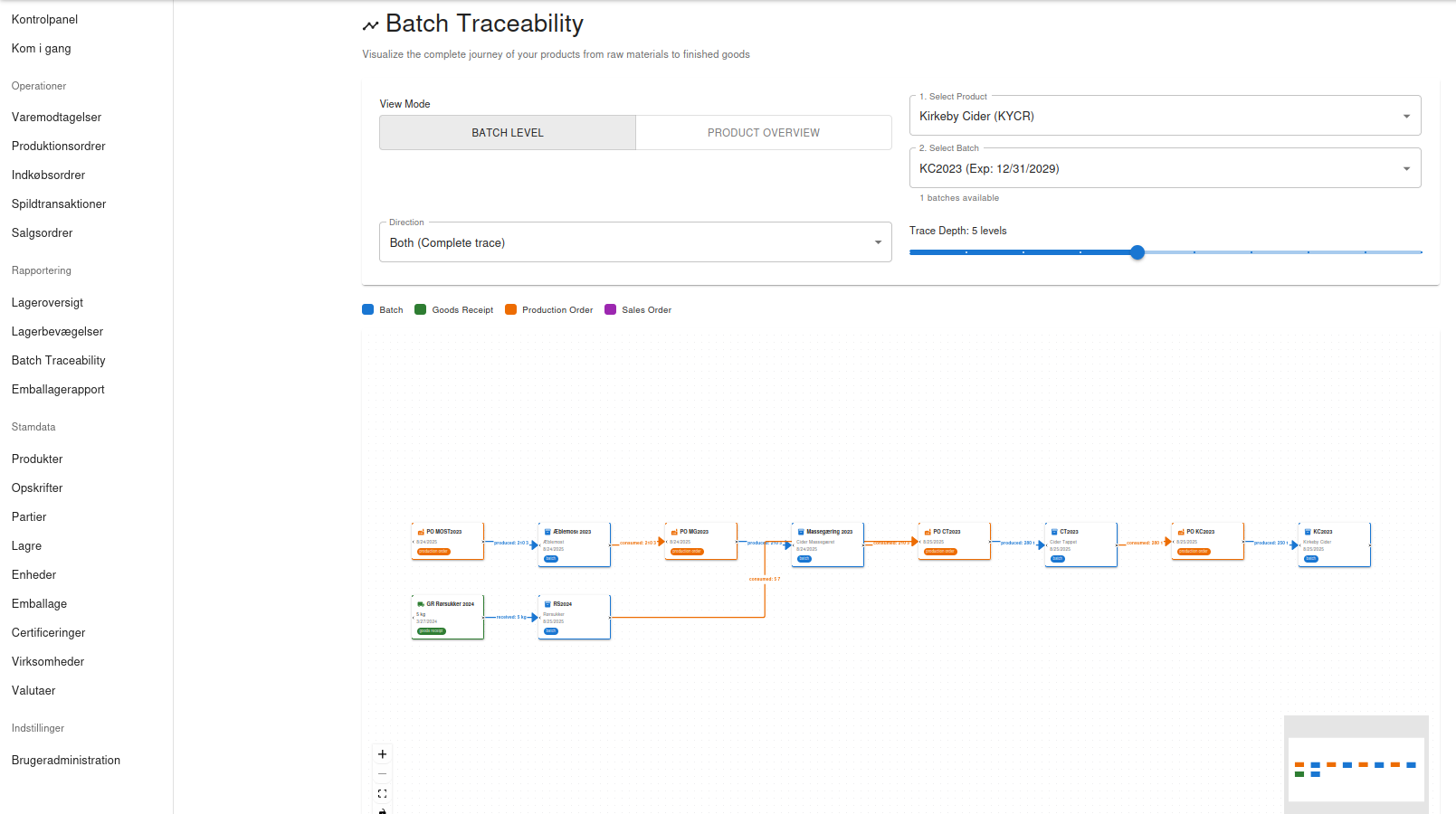
How it works
One click, full chain
Everything is linked
Goods receipts, production and sales all share the same batch records — no manual stitching.
Trace forward or back
Pick a batch and see its full lineage in both directions.
Be recall-ready
If something is wrong, know exactly what is affected and where it went — in seconds.
What powers it
Recall-ready, not spreadsheet-ready
The traceability auditors ask for, without the busywork.
- Forward & backward batch tracing
- Full chain of custody
- Instant recall scoping
- Blend & multi-input lineage
Both directions, from any batch
Traceability is only useful under pressure, and the pressure comes in two shapes. A supplier tells you a delivery was contaminated and you need every product it reached; or a customer complains about one bottle and you need everything that went into it. fermt answers both from the same batch records — forward to the finished goods and shipments, backward to the raw lots and suppliers.
The chain is a by-product of ordinary work rather than a parallel record. A goods receipt creates the batch and captures the supplier and cost; production orders consume batches and create new ones with lineage to their inputs; sales orders allocate batches to shipments. Nobody maintains a traceability file, because the trace is the movements.
- Forward from a raw lot to every product and shipment it reached
- Backward from a finished batch to its inputs and suppliers
- Certificates attached to the batches they covered
- Quality data and stock level visible on the batch record
A recall is a timed exercise
Authorities do not ask whether you can trace a batch; they ask how quickly. The difference between a system that stores the data and one that answers the question is whether the scope of a recall can be produced in minutes without a spreadsheet reconstruction. Because batches carry their lineage, the affected set is a query rather than an investigation.
The same records answer the quieter version of the question. When a customer queries a specific delivery months later, the batch shows what went into it, which certificate was valid on the day it was made, and where the rest of that batch went.
Questions we get
Traceability questions we get asked
How far back does a trace go?
As far as the records do. Each production order links its output batch to the input batches it consumed, so a trace walks the chain stage by stage back to the goods receipts and the suppliers behind them.
Does traceability need extra data entry?
No. It is assembled from goods receipts, production orders and sales orders — work you have to record anyway. There is no separate traceability register to maintain, which is precisely why it stays accurate.
Can we see which certificate applied to a batch?
Yes. Certifications attach to products and batches, so a batch shows the certificate that was valid when it was made rather than only what the company holds today. That is usually the question being asked when a specific delivery is queried.
What about partial shipments?
Delivery notes handle partial shipments against a sales order, so the trace forward reaches the specific consignments a batch actually went out on.
Is this enough for a recall exercise?
It gives you the scope quickly — every product a lot reached and every customer it shipped to. The decisions and the communication remain yours; what fermt removes is the reconstruction that usually eats the first hours.
Who relies on this
Crafts that lean on this most
Ready to get out of spreadsheets?
Start your free trial today, or talk to us about your setup.